

THE STORY OF A PHOTOGRAPH
In 1978 whilst wandering around the Jewish ghetto in Rome I took a photograph by the Portico d’Ottavia. Two ladies looking out at their neighbourhood from their balconies. A typical Roman scene of the era. A couple of prints were made in my darkroom in Rome at the time, but after moving back to England the negatives were left undisturbed for years and were moved from house to house in London and in Suffolk.
When I moved into my current apartment I built a darkroom and made some more prints. The photograph was posted to social media and subsequently appeared on a couple of other sites, one of which got thousands of likes and many responses. I was touched and a little bit surprised that over four decades later my photograph had resonated with so many people.
One of the contributors, Valentina Limentani, happened to be the granddaughter of one of the women portrayed. I contacted her to ask about her grandmother. This is what she wrote:
My grandmother Rosa Efrati was born in Rome on October 4, 1919, into a middle-class family, she was the third of four children, her mother Sofia Pavoncello was a housewife and her father Leone Efrati a merchant.
Her life was that of any little girl, but then in 1938 the Leggi Razziali (racial laws) were enacted in Rome and limitations imposed. My grandmother (in the upper floor of the photograph) lived in that house where you photographed her together with her mother, father, sister Enrica (portrayed on the lower floor) and uncle Angelo (mother’s brother).
October 16 1943* arrives and they have to leave that house. My grandmother had left home very early that day to go get cigarettes, while a gentleman was in line realising that she was Jewish tells her that he sees some trucks (with German soldiers), then my grandmother runs home to to warn her family who hastily descend and take refuge in the church in front of their house.
Unfortunately, on April 21, 1944, her father was taken to Via Tasso beaten up, deported and died in Auschwitz. After the war, she met and married my grandfather Pacifico Limentani. They have 4 children: Rina, Settimio, Nadia and Leo (my father).
Rosa’s life continued, surrounded by the family she built. Rosa died in Rome on November 18, 2000
(* Now known as Sabato Nero (Black Saturday) when 1,259 people, 363 men, 689 women and 207 children were detained by the SS and the Ordnungspolizei. Of those 1023 were deported to Auschwitz. Only sixteen returned after the war, fifteen men and one woman.)
I was very touched by the story and told Valentina that the next time I visited Rome I would take her two prints of the 1978 photograph for her and her father as gifts. As when we met for coffee we were not from the Portico D’Ottavia I took a photograph of Leo and Valentina outside her grandmother’s house.
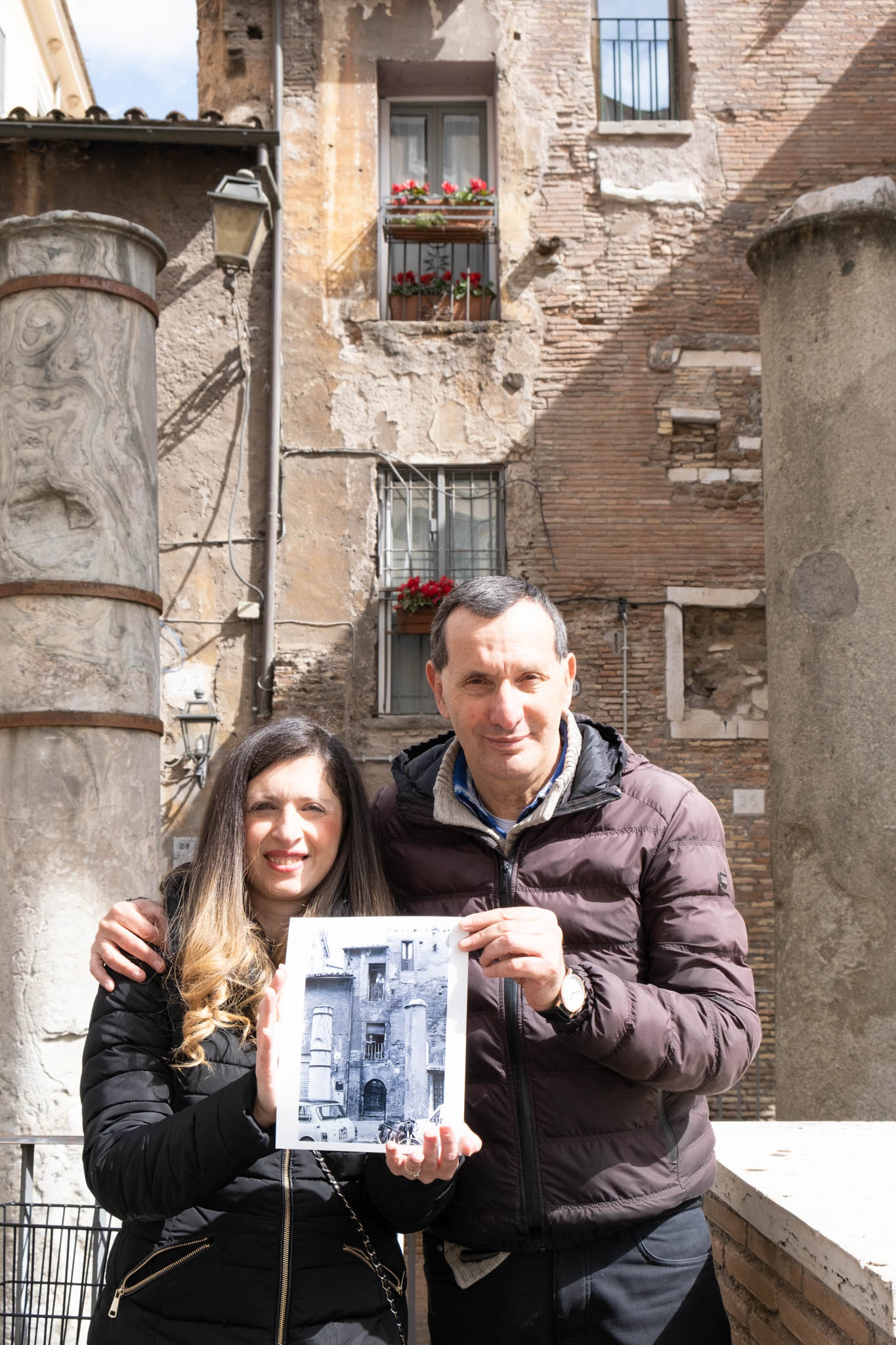
Leo and Valentina outside her grandmother’s house
Since then Valentina and I have occasionally corresponded and have agreed to meet up with her and her father Leo the next time I visit Rome. So not only do I have an interesting story to tell, but have also made new friends.